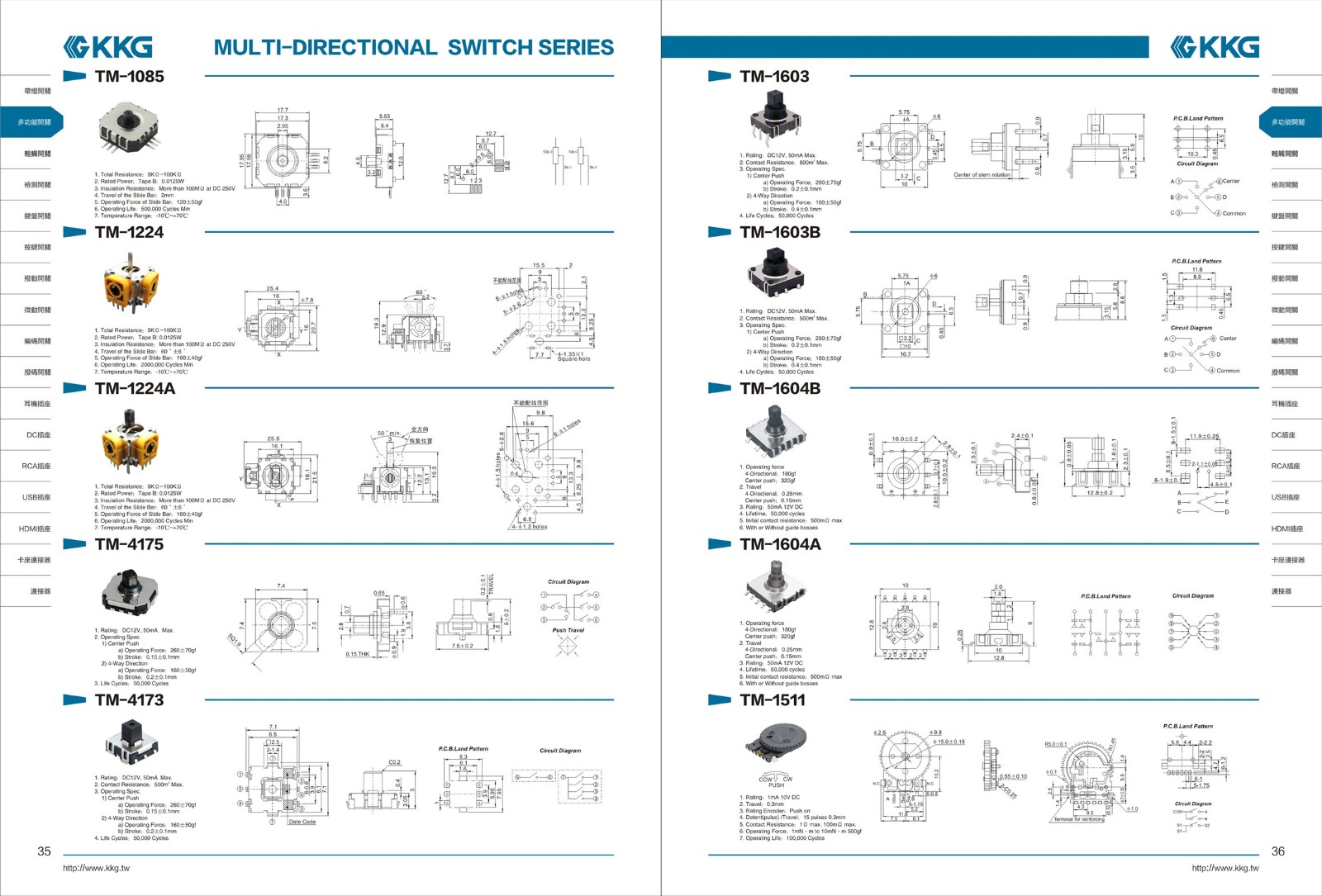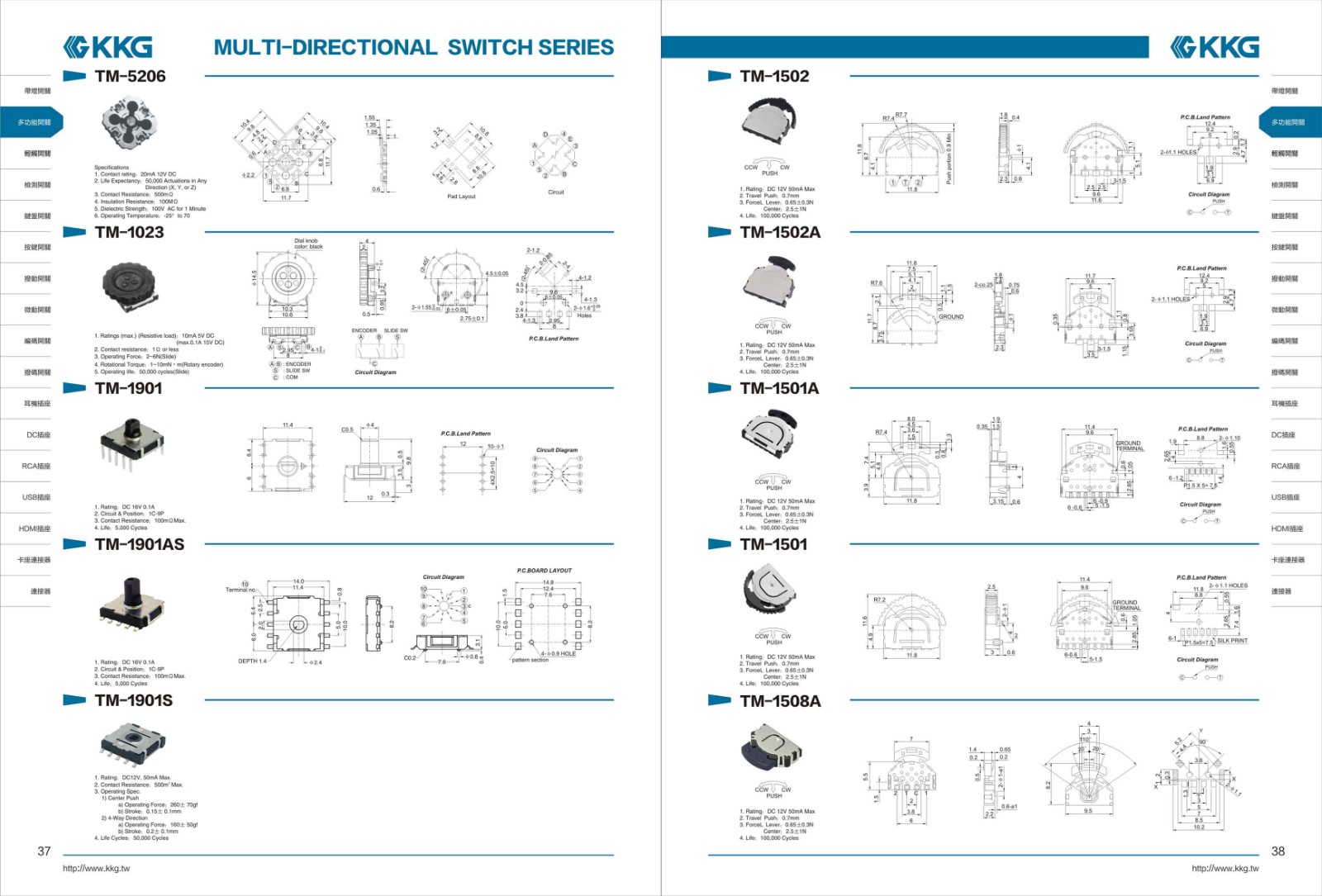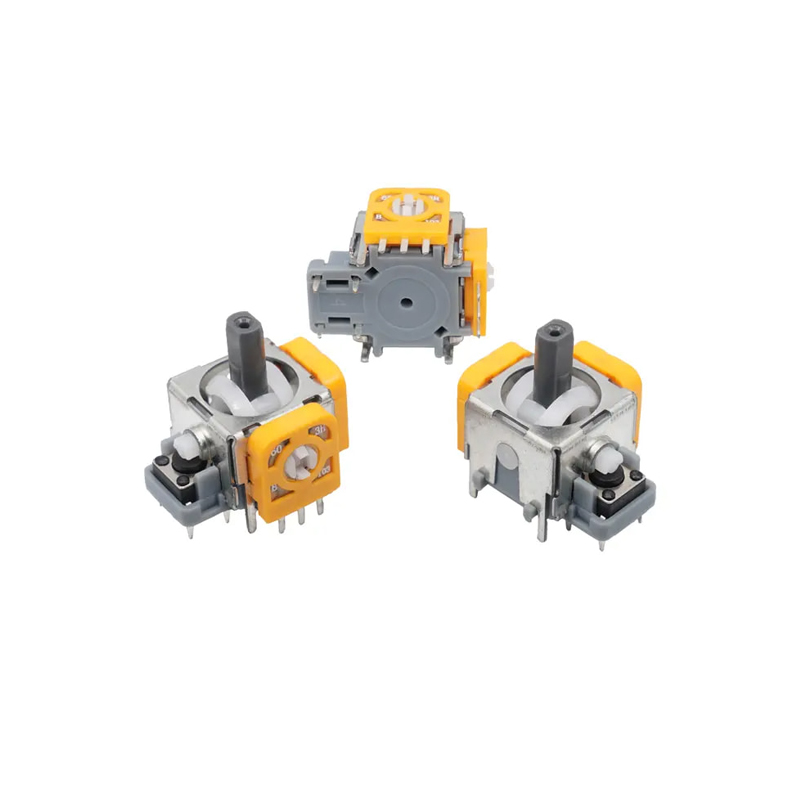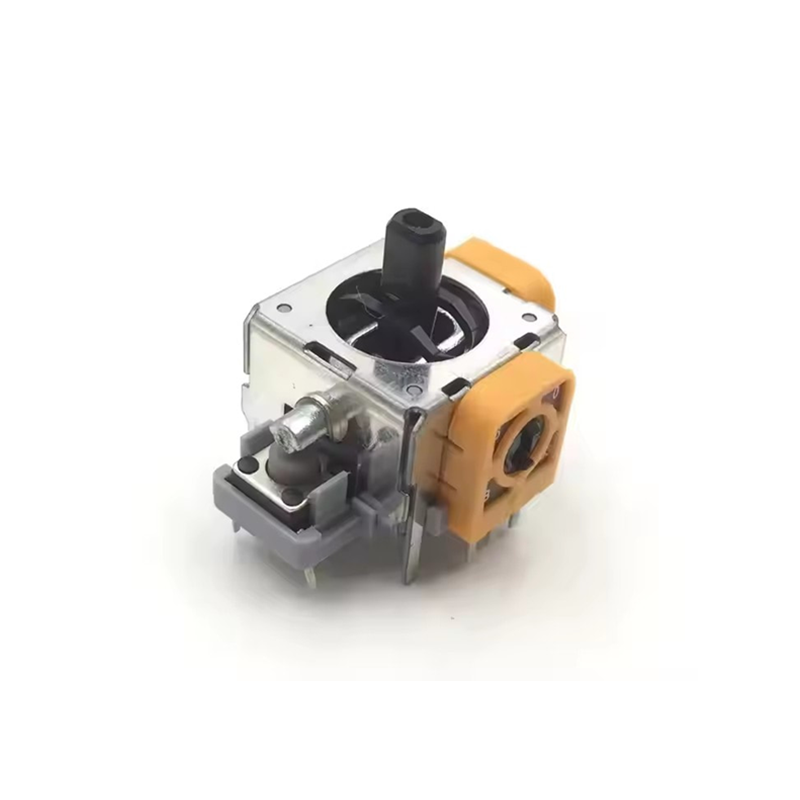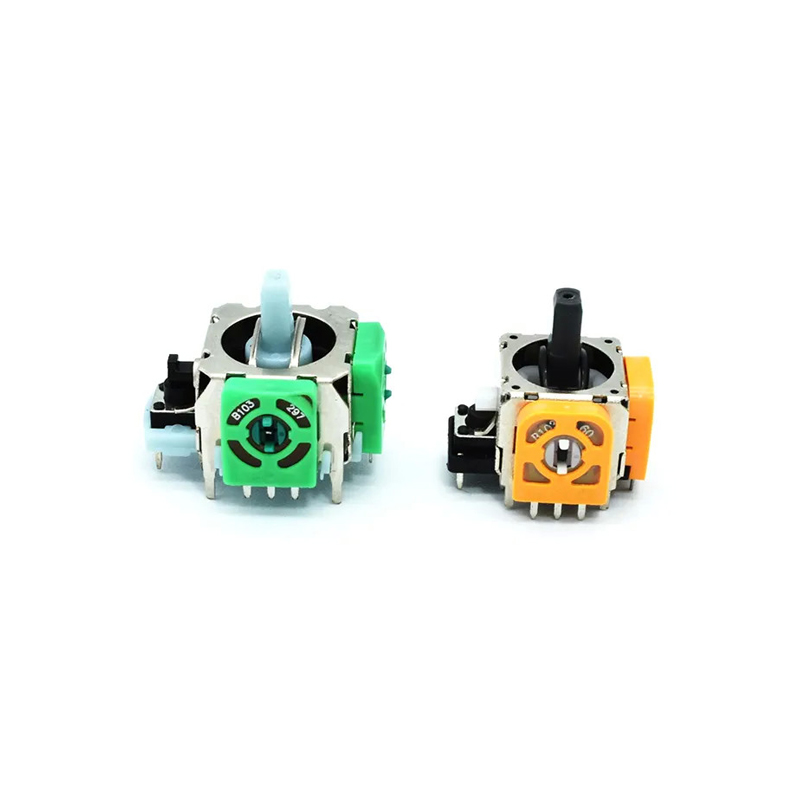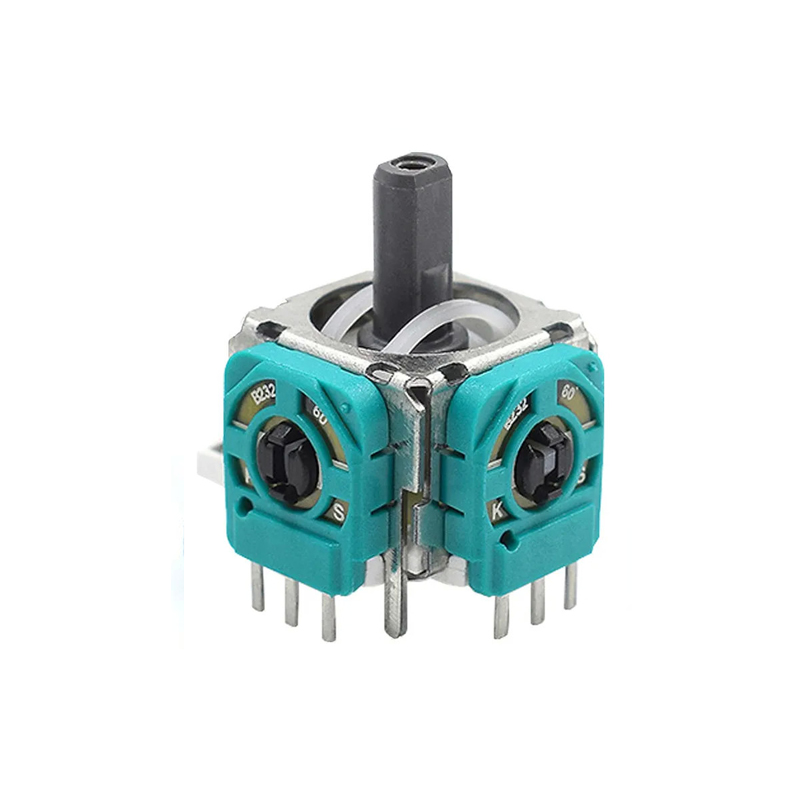
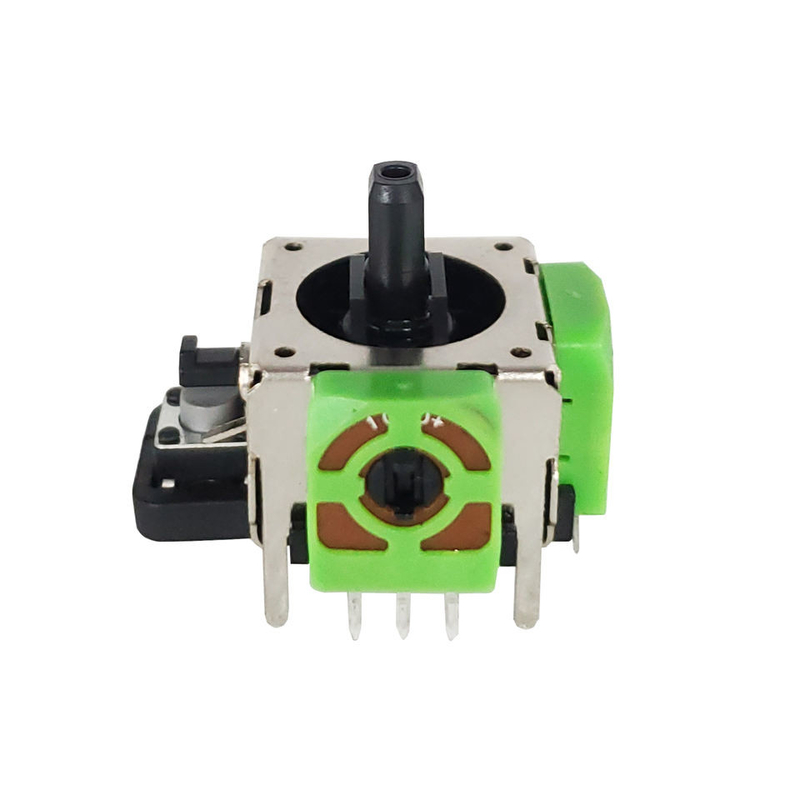
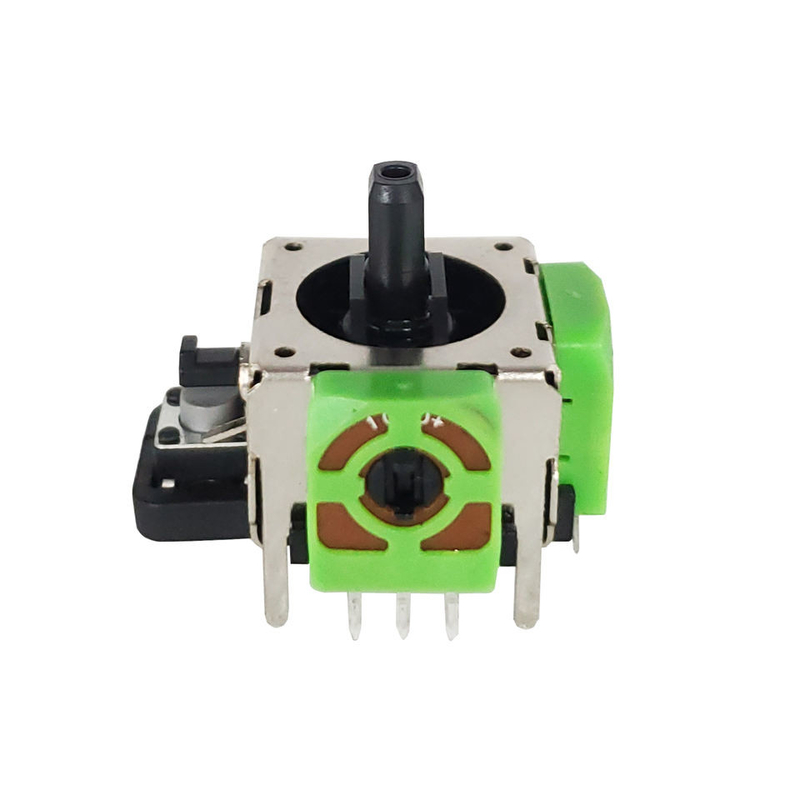
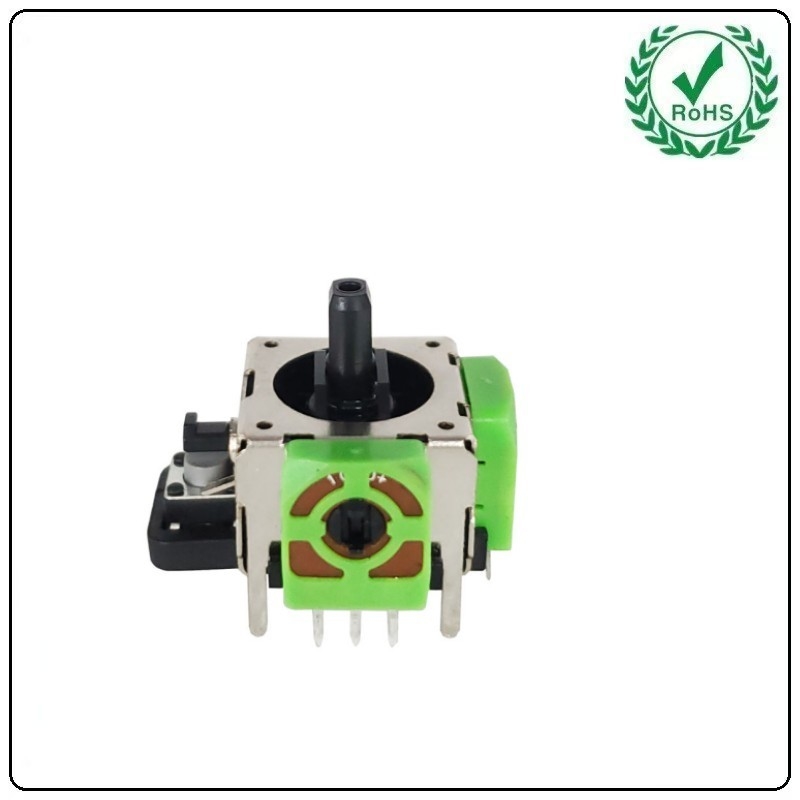
The Joystick Potentiometer is a compact 3D analog stick sensor module designed for game controllers, UAV control systems, electronic toys, remote controls, and other devices requiring precise multi-directional control. Featuring a carbon resistive element, B taper, adjustable resistance from 10KΩ to 100KΩ, and a lever operating angle of 55 ±6°, this component provides responsive and stable analog signal control.
This 3D Analog Stick Sensor combines joystick operation with potentiometric signal detection and an integrated Tact Switch. Its compact structure and long operating life of 100,000 cycles minimum make it suitable for applications where frequent directional operation and reliable control are required.
Product Details
| Place of Origin | Guangdong, China | Model Number | KKG-rj16 |
| Brand Name | KKG | Certificate | RoHS, ISO9001 |
| Technology | Carbon Film | Resistive Material | Carbon |
| Type | Joystick Potentiometer | Rotation | 360° |
| Total Resistance | 10KΩ–100KΩ | Resistance Tolerance | ±20% |
| Resistance Taper | B | Rated Power | 0.0125W |
| Maximum Operating Voltage | AC 50V / DC 5.0V | Operating Life | 100,000 cycles Min. |
Key Features of the Joystick Potentiometer
1. 3D Analog Stick Control
The 3D analog stick sensor is designed to detect joystick movement and convert mechanical displacement into variable electrical signals. This enables electronic systems to recognize directional input and provide proportional control.
2. B10K Replacement Compatibility
With a B-taper configuration and resistance options ranging from 10KΩ to 100KΩ, the component can be used as a B10K replacement analog stick sensor in suitable controller and electronic control applications.
3. Carbon Film Resistive Element
The joystick potentiometer uses a carbon resistive material to provide variable resistance during lever movement. The carbon film construction is suitable for compact control components requiring stable electrical performance.
4. Long Operating Life
The specified operating life is 100,000 cycles minimum. This makes the joystick potentiometer suitable for equipment where the control lever is frequently operated during normal use.
5. Smooth and Responsive Operation
The lever is designed for responsive directional movement, with an operating force of up to 300 gf.cm and a lever operating angle of 55 ±6°. These characteristics help provide controlled and repeatable joystick operation.
6. Integrated Tact Switch
In addition to analog joystick control, the component incorporates a tact switch that can provide an additional push-button input. This allows directional control and button activation to be integrated into a single compact component.
Electrical Specifications
| Electrical Parameter | Specification |
|---|---|
| Total Resistance | 10KΩ–100KΩ |
| Total Resistance Tolerance | ±20% |
| Resistance Taper | B |
| Maximum Operating Voltage | B Taper: AC 50V / DC 5.0V |
| Rated Power | B Taper: 0.0125W |
| Sliding Noise | Less than 300mV, by JIS method |
| Insulation Resistance | More than 100MΩ at DC 250V for 1 minute |
| Withstand Voltage | 1 minute at AC 250V / 2mV / 50Hz |
| Operating Life | 100,000 cycles Min. |
Mechanical Specifications
| Mechanical Parameter | Specification |
|---|---|
| Lever Operation | Circular Operating |
| Stopper Strength | 3.1 kgf.cm Min. for 3 sec |
| Push-Pull Strength | 5.0 kgf Min. for 3 sec |
| Operating Force | 300 gf.cm Max. |
| Rest Position Accuracy | ±5° |
| Lever Operating Angle | 55 ±6° |
Tact Switch Specifications
| Parameter | Specification |
|---|---|
| Maximum Rating | 12V DC, 50mA |
| Operating Force | 820 ±260 gf |
| Travel | 0.5 +0.5 / −0.4 mm |
How Does a Joystick Potentiometer Work?
A joystick potentiometer converts the mechanical movement of a control lever into a variable electrical signal. When the lever moves in a particular direction, the internal sliding contact changes its position along the resistive element.
This movement changes the resistance between the electrical terminals. The electronic controller can then detect the change in voltage or resistance and interpret it as a directional input.
For a 3D analog stick system, multiple potentiometric sensing axes can be used to detect different directions of movement. The controller processes these changing signals to determine the position and movement of the joystick.
The integrated tact switch provides an additional input when the joystick is pressed. This allows one component to provide both analog directional information and a push-button signal.
Operating process:
Joystick movement → Mechanical displacement → Resistive change → Analog signal → Controller interprets directional input
Applications of the 3D Analog Stick Sensor
Game Controllers
The 3D analog stick sensor is suitable for game controllers that require proportional directional input. The potentiometric mechanism allows the controller to detect not only direction but also the degree of lever movement.
UAV Control Systems
A UAV Rotary Potentiometer or joystick potentiometer can be used in remote-control interfaces for unmanned aerial vehicles. The analog output can be used to provide proportional control signals for different flight or operational functions, depending on the system design.
Remote Controls
The compact joystick structure can be integrated into remote-control equipment requiring multi-directional manual input and additional push-button operation.
Electronic Toys
Joystick potentiometers can be used in electronic toys and interactive devices where users need to control movement or functions through a small analog stick.
Industrial Control Interfaces
For selected compact control systems, the component can provide a convenient analog input interface for manual directional adjustment and parameter control.
Advantages of This Joystick Potentiometer
Multi-directional analog control: Converts joystick movement into variable electrical signals.
Wide resistance range: Available resistance specification from 10KΩ to 100KΩ.
B taper: Suitable for applications requiring B-type resistance characteristics.
Carbon film construction: Provides a practical resistive element for compact electronic controls.
Long operating life: Rated for a minimum of 100,000 operating cycles.
Integrated tact switch: Adds push-button functionality to the joystick assembly.
Compact control solution: Suitable for game controllers, UAV equipment, remote controls, and electronic devices.
Responsive operation: Designed for repeatable lever movement and directional input.
Joystick Potentiometer vs. Standard Rotary Potentiometer
| Feature | Joystick Potentiometer | Standard Rotary Potentiometer |
|---|---|---|
| Control Method | Lever / joystick movement | Rotary shaft movement |
| Directional Input | Multi-directional | Rotational |
| Typical Application | Game controllers, UAV controls, remote controls | Audio, lighting, electronic controls |
| User Interface | Analog stick | Rotary knob |
How to Choose a B10K Replacement Analog Stick Sensor?
When selecting a B10K replacement analog stick sensor, the resistance value is one of the most important parameters to check. A B10K configuration generally refers to a 10KΩ nominal resistance with B-type taper characteristics.
However, resistance is not the only factor. Before replacing an existing joystick potentiometer, engineers should also verify the mechanical dimensions, mounting configuration, lever structure, operating angle, terminal arrangement, electrical characteristics, and tact switch specifications.
For production applications, the expected operating frequency and service life should also be considered. This model provides a minimum operating life of 100,000 cycles, which can support applications involving frequent joystick movement.
Quality and Reliability
Stable electrical performance and mechanical durability are important for joystick components because they are repeatedly operated during normal product use. This joystick potentiometer uses a carbon resistive element and is designed according to specified electrical and mechanical performance requirements.
The product is available with RoHS and ISO9001 certification support, making it suitable for electronic component sourcing where material compliance and quality management are important considerations.
Joystick Potentiometer Manufacturer
As a professional joystick potentiometer manufacturer, we provide rotary potentiometer and analog control components for electronic equipment manufacturers and OEM applications. Our products can be evaluated according to resistance value, taper, mechanical configuration, operating angle, electrical characteristics, and application requirements.
Whether you are sourcing a B10K replacement potentiometer for a game controller, an analog stick sensor for UAV equipment, or a custom joystick potentiometer for a new electronic device, our team can help identify a suitable configuration based on your technical requirements.
Contact us to discuss your project requirements, product specifications, sampling needs, and OEM or customization options.
FAQ
What is a joystick potentiometer?
A joystick potentiometer is an electromechanical component that converts joystick or lever movement into variable electrical resistance. It is commonly used to provide analog directional input in controllers and electronic devices.
What is a 3D analog stick sensor?
A 3D analog stick sensor is a control component designed to detect multi-directional joystick movement and convert the mechanical position into electrical signals that an electronic controller can process.
What does B10K mean?
B10K generally indicates a 10KΩ nominal resistance with a B-type resistance taper. The actual replacement component should also be matched to the original mechanical dimensions and electrical configuration.
Can this joystick potentiometer be used for UAV applications?
Yes. The joystick potentiometer can be considered for UAV remote-control interfaces and other control systems requiring analog directional input, provided its electrical and mechanical specifications match the target application.
What is the operating life of this joystick potentiometer?
The specified operating life is 100,000 cycles minimum.
What is the lever operating angle?
The specified lever operating angle is 55 ±6°, with a rest position accuracy of ±5°.
Does the component include a tact switch?
Yes. The product includes an integrated tact switch with a maximum rating of 12V DC and 50mA, an operating force of 820 ±260gf, and a specified travel of 0.5 +0.5 / −0.4mm.
The Joystick Potentiometer 3D Analog Stick Sensor is a compact solution for multi-directional analog control in game controllers, UAV remote controls, electronic toys, and related electronic equipment. With 10KΩ–100KΩ resistance, B taper, carbon film technology, 55 ±6° lever operating angle, integrated tact switch, and 100,000-cycle minimum operating life, it provides a practical combination of analog sensing and push-button functionality.
For B10K replacement requirements, OEM projects, or bulk sourcing of joystick potentiometers and 3D analog stick sensors, contact us with your application and technical specifications.